OEM vs ODM Watches for Private-Label Brands
- WILSON LEUNG
- Jul 11
- 6 min read
A watch collection can look complete on a mood board and still fail at the production stage. Case dimensions, movement fit, dial printing, water resistance, material availability, and packaging all need to work together. The OEM vs ODM watches decision determines how much of that work your brand controls, how quickly you can launch, and where you invest your budget.
For private-label brands, retailers, distributors, and promotional product companies, neither model is automatically better. The right choice depends on the product position, sales plan, development budget, and level of differentiation required. A clear decision at the beginning prevents costly redesigns, unclear ownership, and production delays later.
OEM vs ODM Watches: The Core Difference
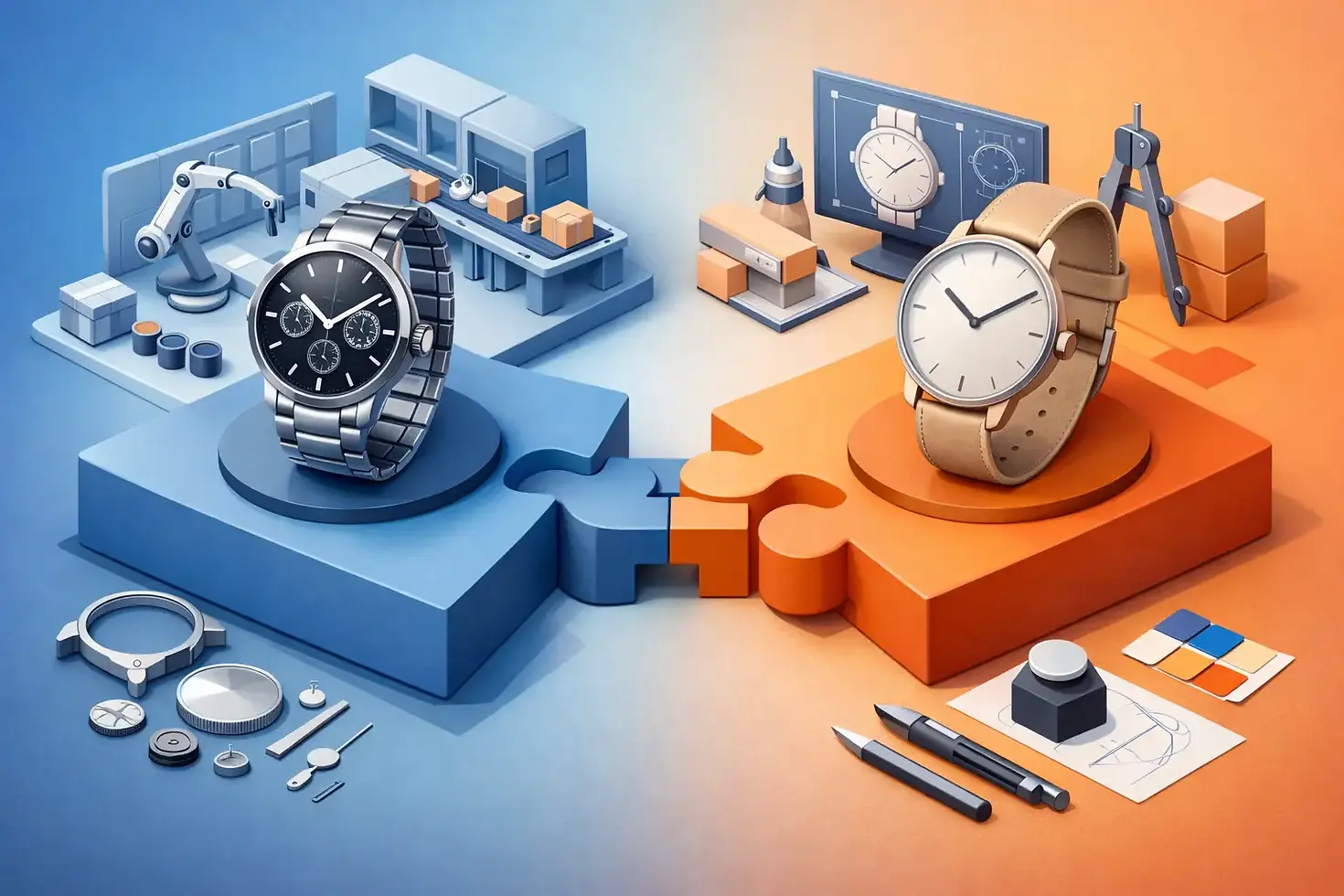
OEM stands for Original Equipment Manufacturer. In a watch project, OEM production generally means the buyer provides the product concept, technical requirements, or a detailed design direction, while the manufacturer develops and produces the watch to those specifications. The customer has greater influence over the final product, from case shape and materials to dial layout, hands, strap construction, and packaging.
ODM stands for Original Design Manufacturer. Under an ODM approach, the manufacturer begins with established product designs, components, or watch platforms. The buyer selects a suitable base model and customizes defined elements, such as the logo, dial color, strap, buckle, case finish, or gift box. This route uses proven manufacturing structures rather than starting every engineering detail from zero.
The practical difference is straightforward: OEM gives a brand more product control and originality, while ODM offers a faster and lower-risk path built around existing designs.
However, terminology can vary between suppliers. One factory may use OEM to describe any private-label watch with a customer logo, while another uses it only for a fully custom project. Before approving a quotation, define the scope in writing: which components are new, which components are standard, who approves drawings, and who owns the final design files.
When ODM Watches Are the Better Business Choice
ODM is often the right starting point when speed, market testing, or controlled investment matters more than creating a completely new watch architecture. A brand may want to enter the watch category for the first time, add timepieces to an existing fashion line, or build a promotional collection for a corporate customer. In these cases, a well-selected existing platform can deliver a professional product without a lengthy development cycle.
Customization should not be mistaken for a simple logo application. An effective ODM project can still create a distinct identity through dial design, color matching, case coating, strap material, custom embossing, branded crowns, packaging, and coordinated accessories. The key is understanding which features are available within the platform and which changes require additional engineering or tooling.
ODM typically reduces development time because the case construction, movement compatibility, and assembly process have already been established. It can also lower the minimum order quantity compared with a fully custom program, although quantities vary by material, movement, and customization level.
The trade-off is exclusivity. If the underlying case or bracelet design is part of a supplier's catalog, other customers may use the same base structure. Your dial, colors, and branding can be unique, but the overall silhouette may not be. For a price-sensitive collection or a quick market launch, that may be an acceptable and commercially sound decision.
When OEM Watch Manufacturing Makes Sense
OEM is better suited to brands that need a watch to express a defined design language or meet a particular product requirement. This may include a distinctive case profile, a proprietary dial construction, a special material combination, a custom bracelet, or dimensions designed for a specific customer segment.
A serious OEM watch project begins with clear specifications. A manufacturer needs more than a reference image to produce consistently. Product development should address case size and thickness, material grade, crystal type, movement, dial indexes, hand length, strap fit, buckle style, water-resistance target, finishing standard, and packaging requirements. Each decision affects appearance, performance, cost, and production timing.
Custom tooling may be required for a new case, bezel, dial element, buckle, or bracelet component. Tooling increases the initial investment, but it can create a product that competitors cannot easily duplicate. For an established retailer, a watch brand with long-term distribution plans, or a company developing a flagship collection, that differentiation can justify the added cost.
OEM also requires more disciplined approvals. Technical drawings, material samples, color standards, pre-production samples, and final production samples should be reviewed before mass production begins. Skipping these stages may seem faster, but it creates greater risk when changes are expensive or impossible after assembly has started.
Compare Cost, Time, and Product Control
The decision is not simply OEM equals expensive and ODM equals cheap. The real question is where your investment delivers value.
ODM usually has lower upfront development costs because the manufacturer relies on existing components and established construction. Sampling can move more quickly, and production planning is often simpler. This supports brands that need to validate demand before committing to a larger product program.
OEM generally requires a higher upfront commitment. New tooling, engineering, development samples, and component sourcing can add cost and time. Yet the unit economics may improve as volumes grow, particularly when a successful design becomes a repeat program. More importantly, an OEM product can support stronger brand positioning when its design, materials, and details are difficult to find elsewhere.
Lead time also depends on component availability. An ODM model with a standard movement and stocked case may move quickly, while a customized ODM project using a special plating color, uncommon dial material, or custom strap can require additional time. Likewise, some OEM projects proceed efficiently when drawings are final, approvals are prompt, and tooling is planned correctly.
Product control follows the same pattern. ODM provides control over selected visual and commercial details. OEM provides greater control over the full product specification, but it also requires the buyer to make more decisions and approve them on schedule.
Quality Requirements Do Not Change by Model
Whether a watch is OEM or ODM, quality control must be defined before production. A catalog-based model is not automatically high quality, and a fully custom watch is not automatically better made. The result depends on component selection, production discipline, testing, and inspection standards.
For a reliable watch program, buyers should establish requirements for the movement, case material, plating or coating, crystal, strap durability, water resistance, dial printing, and packaging. The intended retail price and customer use case should guide those choices. A fashion watch sold for occasional wear has different requirements from a daily-wear stainless steel model or a promotional item produced for a short campaign.
Inspection should cover cosmetic consistency as well as functional performance. Case finishing, logo placement, dial alignment, hand clearance, strap stitching, clasp operation, timekeeping, and water-resistance testing all deserve attention. A professional manufacturer should be able to discuss these production checkpoints directly rather than treating quality as a general promise.
Questions to Settle Before Requesting a Quote
A productive inquiry gives the manufacturer enough information to recommend the right route. Start with your target retail price, expected order quantity, target delivery date, sales market, and reference designs. Then clarify the level of customization you need.
If you are considering ODM, ask which components can be changed without new tooling, whether the base design is available to other customers, and what sample options are available. If you are considering OEM, ask which parts require tooling, how development milestones are managed, and what files or specifications you must provide.
In both cases, confirm the production quantity, sample approval process, quality standard, payment terms, packaging requirements, and responsibilities for shipping documentation. It is also wise to discuss replacement-part availability for straps, buckles, and batteries when the collection is intended for long-term retail sales.
Design ownership deserves specific attention. Your agreement should identify ownership of custom artwork, molds, tooling, technical drawings, and exclusive components. This is particularly relevant when a design is central to your brand identity or will be sold across multiple seasons.
Choose the Manufacturing Route That Supports Your Plan
ODM is a practical choice when you need proven watch structures, faster development, and meaningful customization within a controlled budget. OEM is the stronger route when your collection depends on original design, exclusive details, and long-term brand differentiation.
HONOUR TIME CORPORATION LTD. works with both approaches because the best manufacturing solution starts with the buyer's commercial objective, not a predetermined production model. A clear product brief, realistic timeline, and firm quality standard give any watch project a stronger foundation. Bring those decisions to the first manufacturing discussion, and the path from concept to production becomes far more manageable.


Comments