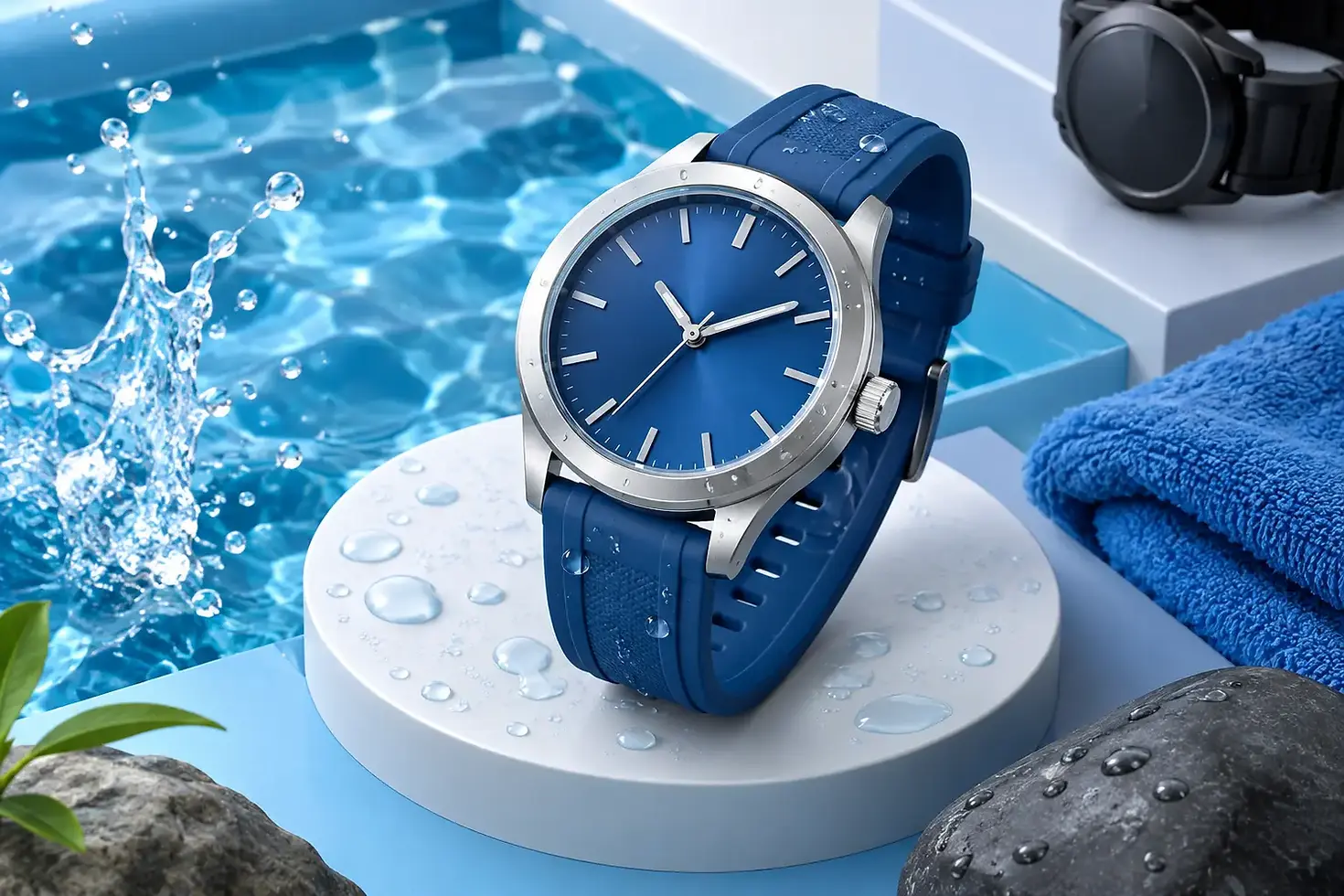
Watch Water Resistance Review for Custom Brands
A water-resistance claim can determine whether a customer sees a new watch as a dependable daily product or a costly return waiting to happen. This watch water resistance review is written for brands developing custom watches, where the rating printed on the dial must match the case design, components, assembly process, and final inspection standard.
For OEM and ODM programs, water resistance is not a decorative specification. It is a system requirement. A well-designed 5 ATM watch can fail if the crown seal is poorly fitted, the caseback gasket is damaged during assembly, or the stated rating is applied without appropriate testing. The correct starting point is not the dial marking. It is the intended use of the finished product.
What Water-Resistance Ratings Actually Mean
Water resistance is commonly expressed in ATM, bar, meters, or feet. These values describe the pressure a watch is designed to withstand under controlled conditions. They do not automatically describe the depth at which a consumer can use the watch in every real-world situation.
A 3 ATM or 30-meter rating is generally appropriate for accidental splashes, rain, and routine hand washing. It should not be positioned as a swimming watch. A 5 ATM or 50-meter rating is typically suitable for surface swimming, provided the watch has been properly tested and the crown remains fully closed. A 10 ATM or 100-meter rating is a more practical choice for active lifestyle collections, water sports, and regular swimming. Higher ratings may be required for diving-oriented products, but the design and testing obligations also increase.
The difference matters because water creates dynamic pressure. Jumping into a pool, moving an arm quickly through water, or directing a shower stream at a watch can produce conditions that differ from a static laboratory test. Temperature changes can also affect sealing materials. For this reason, a responsible product specification should reflect normal customer behavior, not only the largest number that can be printed on a caseback.
Watch Water Resistance Review: The Parts That Control Performance
A watch case becomes water resistant only when several interfaces work together. The crystal, crown, caseback, pushers, gaskets, tube construction, and case geometry must be selected as a matched system. Improving one component while overlooking another does not produce a reliable result.
Case and crystal fit
The watch case provides the foundation for the entire sealing design. Caseback threads or screw locations must be machined consistently, with enough compression to maintain the gasket seal. The crystal must fit the bezel or crystal seat accurately. A minor variation in the seating surface can create a leakage path even when the visible finish appears acceptable.
Mineral glass, sapphire crystal, and acrylic can all be used in water-resistant watches. The appropriate choice depends on the product position, target price, visual design, and expected use. Sapphire offers excellent scratch resistance, while mineral glass can support a competitive commercial price point. In either case, dimensional control and correct gasket selection are more important to water resistance than the crystal material alone.
Crown and pusher design
The crown is often the most vulnerable point in a conventional watch. A push-pull crown can support water resistance when the tube, gaskets, and assembly are properly engineered. However, a screw-down crown provides an additional mechanical safeguard for higher-rated sports watches. It is especially useful for 10 ATM and above, though it adds cost and affects the user experience.
Chronograph pushers require separate attention. Each pusher introduces another moving opening in the case. If a brand wants a chronograph intended for swimming or frequent water exposure, the pusher structure and seal design must be specified early. A standard-looking case cannot simply receive a higher water-resistance claim at the end of development.
Gaskets and assembly control
Gaskets are small components with a major effect on long-term performance. Their material, size, lubrication, placement, and compression must be controlled. Silicone, nitrile rubber, and fluorocarbon materials each have different performance characteristics, costs, and suitability for chemical exposure or temperature changes.
Assembly discipline is equally critical. A gasket that is twisted, contaminated, pinched, dry, or incorrectly seated may cause leakage even if every component meets its drawing. Production teams should use defined work instructions and inspection points for the crystal, crown, caseback, and any pushers. This is where manufacturing reliability becomes visible in the finished watch.
Choosing the Right Rating for Your Collection
The best rating depends on the commercial purpose of the watch. A slim fashion watch for office and occasion wear does not necessarily need the case thickness, screw-down crown, or cost structure associated with a sport model. For that product, 3 ATM may be appropriate if the customer communication is clear and the watch is tested accordingly.
For a versatile private-label collection that may be worn during travel, exercise, or casual swimming, 5 ATM or 10 ATM is usually a stronger market position. The choice depends on the case design and price segment. A 10 ATM claim can add confidence for consumers, but it requires a more considered construction and should not be treated as a marketing upgrade.
Diver-style watches demand another level of discipline. If a product is promoted for diving, brands should distinguish a high water-resistance rating from compliance with diver-watch requirements. ISO 6425 addresses dedicated diver's watches and includes requirements beyond pressure resistance. It is not enough to copy the visual language of a dive watch while using a general-purpose construction and test process.
Testing Should Be Built Into the Production Plan
Water-resistance testing should be planned before mass production, not introduced after customer complaints. Development samples should be tested to confirm that the proposed case, crystal, crown, and gasket arrangement can achieve the required rating. Any change to the case supplier, crown design, gasket material, or assembly method should trigger a new review.
In production, brands can choose a testing approach based on their quality requirements, order volume, and product risk. Air-pressure testing is useful for identifying leaks without exposing the watch to water. Water-pressure testing can provide additional confirmation for specified ratings. Condensation testing may also help identify moisture ingress after temperature exposure.
A practical quality plan should define the rating, test method, pressure level, sample quantity or inspection percentage, acceptance criteria, and recordkeeping process. For higher-risk collections, 100% testing may be justified. For lower-rated products, an agreed sampling plan may be suitable, but only if component consistency and assembly controls are proven.
The test result must also be interpreted correctly. A watch that passes a factory pressure test is not maintenance-free for its entire service life. Gaskets age, crowns can be damaged, and opening the case for battery replacement or repair can compromise the seal. Brands should provide realistic care instructions and ensure service partners understand how to restore the required sealing condition.
Product Claims Need Clear, Defensible Language
Avoid calling a watch “waterproof.” No consumer watch is immune to every form of water exposure, aging, impact, or improper use. “Water resistant” is more accurate, provided the stated rating has been validated through an appropriate manufacturing and testing process.
Dial and caseback markings should match product documentation, packaging, and sales descriptions. A mismatch between a 5 ATM caseback and broad claims about diving or hot-tub use creates avoidable product liability and customer-service risk. Hot water, steam, soap, chemicals, and operating a crown underwater can all increase the chance of failure, even with a higher-rated watch.
For custom watch programs, the most effective approach is to agree on the intended use before finalizing the case. Honour Time Corporation Ltd. can support that discussion as part of a complete OEM or ODM development process, aligning design direction with practical manufacturing requirements.
Water resistance is a promise made through engineering, assembly, and inspection. Set the promise at the right level, validate it with disciplined testing, and your collection will earn trust where it matters most: on the customer's wrist.



Comments