Water Resistance Testing for Watches Explained
- WILSON LEUNG
- Apr 21
- 6 min read
A watch rated to 5 ATM can still fail in the field if the case, crown, gasket, and assembly process are not controlled with precision. That is why water resistance testing for watches matters far beyond a dial marking. For brand owners, importers, and private-label buyers, it is a quality checkpoint that protects product performance, return rates, and brand credibility.
Why water resistance testing for watches matters in manufacturing
In retail, water resistance is often treated as a simple feature. In production, it is a system result. A watch only passes when the case construction, material tolerances, sealing components, and assembly discipline all work together.
For OEM and ODM projects, this is especially important because water resistance affects both design decisions and production risk. A slim fashion watch with a snap-back case has different limitations than a screw-down crown sports model. If the target market, price point, and product positioning are not aligned with the required resistance level, problems show up later as warranty claims, customer complaints, or shipment disputes.
This is why experienced manufacturers do not treat testing as a final box to check. They treat it as part of engineering validation and production quality control.
What water resistance ratings actually mean
One common source of confusion is the rating itself. Buyers often see 3 ATM, 5 ATM, or 10 ATM and assume those numbers describe real-world usage in a simple way. They do not. These ratings indicate the pressure level the watch is designed and tested to withstand under controlled conditions.
A 3 ATM watch is generally suitable for incidental contact with water, such as hand washing or light splashes. A 5 ATM watch is commonly positioned for daily wear with better resistance to moisture exposure. A 10 ATM watch is more appropriate for active use, depending on case construction and crown design. Beyond the rating, actual product reliability depends on assembly consistency and whether every unit matches the approved sample.
This is where B2B buyers need to stay practical. A higher rating can strengthen the product offer, but it may also increase complexity, component cost, and case design constraints. The right target is not always the highest one. It is the one that fits the intended customer use and can be produced consistently at scale.
How water resistance testing is typically performed
Water resistance testing for watches is usually carried out with either air pressure testing, water pressure testing, or a combination of both. The method depends on the watch type, target rating, and production stage.
Dry testing
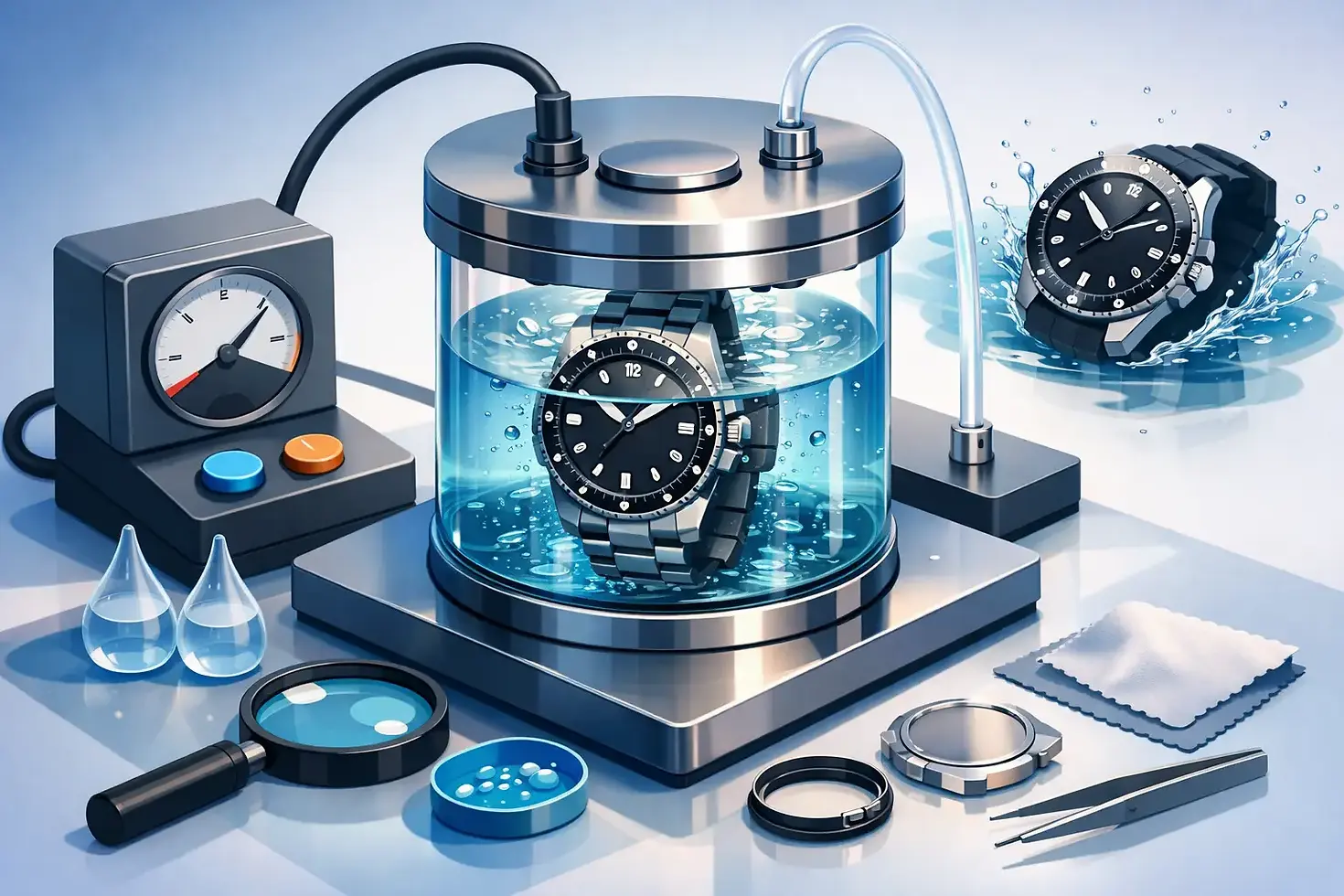
Dry testing uses air pressure rather than water to detect case leakage. In many factories, this is the first and most efficient screening method. The watch is placed in a pressure chamber, and the equipment measures deformation or pressure change to identify whether the case remains sealed.
The advantage is speed and safety. A failed watch does not need to be immersed in water, which helps protect movements and simplifies rework. This method is useful during production because it allows faster inspection of assembled units before final packing.
That said, dry testing has limits. It is highly effective for leak detection, but it still depends on proper equipment calibration and correct test parameters. It should not be treated as a shortcut for poor case engineering.
Wet testing
Wet testing exposes the watch to water under controlled pressure conditions. This method can provide direct confirmation of sealing performance, especially for models with higher water resistance claims.
A common process involves pressurizing the watch in air, then immersing it in water and observing whether escaping air bubbles indicate a leak. More advanced setups may use defined pressure cycles and stricter controls. Wet testing can be valuable for validation, but it also carries more risk if a unit fails, since moisture can enter the case.
For that reason, many manufacturers use dry testing for routine in-line inspection and wet testing for design validation, periodic verification, or special requirements.
The components that determine test results
A water resistance claim is not created by the test machine alone. It starts with design and component selection.
The case back is one of the most critical points. Screw-back cases generally offer better sealing stability than snap-back designs, especially when the product must meet higher resistance targets. The crown is another major factor. A standard push-pull crown may be acceptable for lower ratings, while a screw-down crown is often preferred for more demanding applications.
Gaskets also matter more than many buyers realize. Material quality, dimensional accuracy, compression behavior, and installation condition all affect sealing performance. Even a well-designed watch can fail if the gasket is damaged during assembly or if lubricant application is inconsistent.
Crystal fitting, pusher construction on chronograph models, and the tolerance between mating surfaces all contribute as well. In other words, test performance reflects the whole build, not one isolated part.
Why sample approval is not enough
A prototype that passes is only the starting point. The real issue for commercial buyers is repeatability across production.
This is where manufacturing discipline becomes decisive. If component dimensions vary too much from batch to batch, or if assembly torque is not controlled, the approved sample no longer represents the finished shipment. The watch may still look correct, but water resistance can become inconsistent from unit to unit.
For private-label programs, this is one reason supplier selection matters. A reliable production partner should be able to explain not only the target rating, but also how that rating is verified during pilot runs and mass production. That includes testing frequency, inspection standards, and controls over critical sealing components.
Common failure points in production
When water resistance problems occur, the root cause is often predictable. Crown installation errors are common, especially when assembly is rushed or stem alignment is off. Improper case back closing force can also create leaks. So can dust, debris, or hair trapped on the gasket during assembly.
Material substitution is another risk in cost-sensitive projects. If a lower-grade gasket or inconsistent case component is introduced to reduce cost, the watch may still pass visual inspection while losing sealing reliability. This is why specification control is essential in OEM and ODM work.
There is also the issue of post-test handling. A watch that passes testing can still become vulnerable if it is opened again for battery insertion, dial correction, or final rework without repeating the appropriate quality checks.
What B2B buyers should confirm with a manufacturer
For buyers sourcing custom watches, the right question is not simply, "Can this watch be 5 ATM or 10 ATM?" The better question is, "How will you validate and maintain that level in production?"
Ask how the rating is defined for the model, which test method is used, and whether testing is applied to development samples, pilot units, or mass production batches. Confirm whether the case architecture supports the claimed resistance level. It is also wise to ask how failed units are handled and whether corrective action is traced back to component or assembly causes.
If your product is aimed at fashion retail, gift channels, or promotional distribution, a moderate rating may be enough. If the watch is positioned as a sports or outdoor model, the quality expectation is higher and so is the need for stricter validation. The right answer depends on use case, selling channel, and risk tolerance.
Balancing product goals, cost, and reliability
Higher water resistance is not free. It may require a thicker case, different crown construction, tighter machining control, stronger case back engagement, and more demanding testing. These factors can affect material cost, tooling decisions, and the overall visual profile of the watch.
That does not mean buyers should avoid higher ratings. It means they should make the decision early and build the product around it. Retrofitting stronger water resistance late in development is harder and usually more expensive than planning for it from the start.
A professional manufacturing partner should help align the desired rating with the product concept, target margin, and production feasibility. That approach reduces avoidable revisions and leads to a more dependable final product.
The practical standard buyers should expect
Water resistance should be treated as a verified performance specification, not a marketing label. In a serious watch program, testing should support product design, supplier control, assembly quality, and final inspection.
For buyers working on OEM or ODM projects, the best outcome is not just a watch that passes one lab check. It is a watch that can be produced repeatedly with the same sealing reliability across every shipment. That is the standard worth asking for, because customers do not judge water resistance by the case back engraving. They judge it when the watch meets real use without failure.


Comments