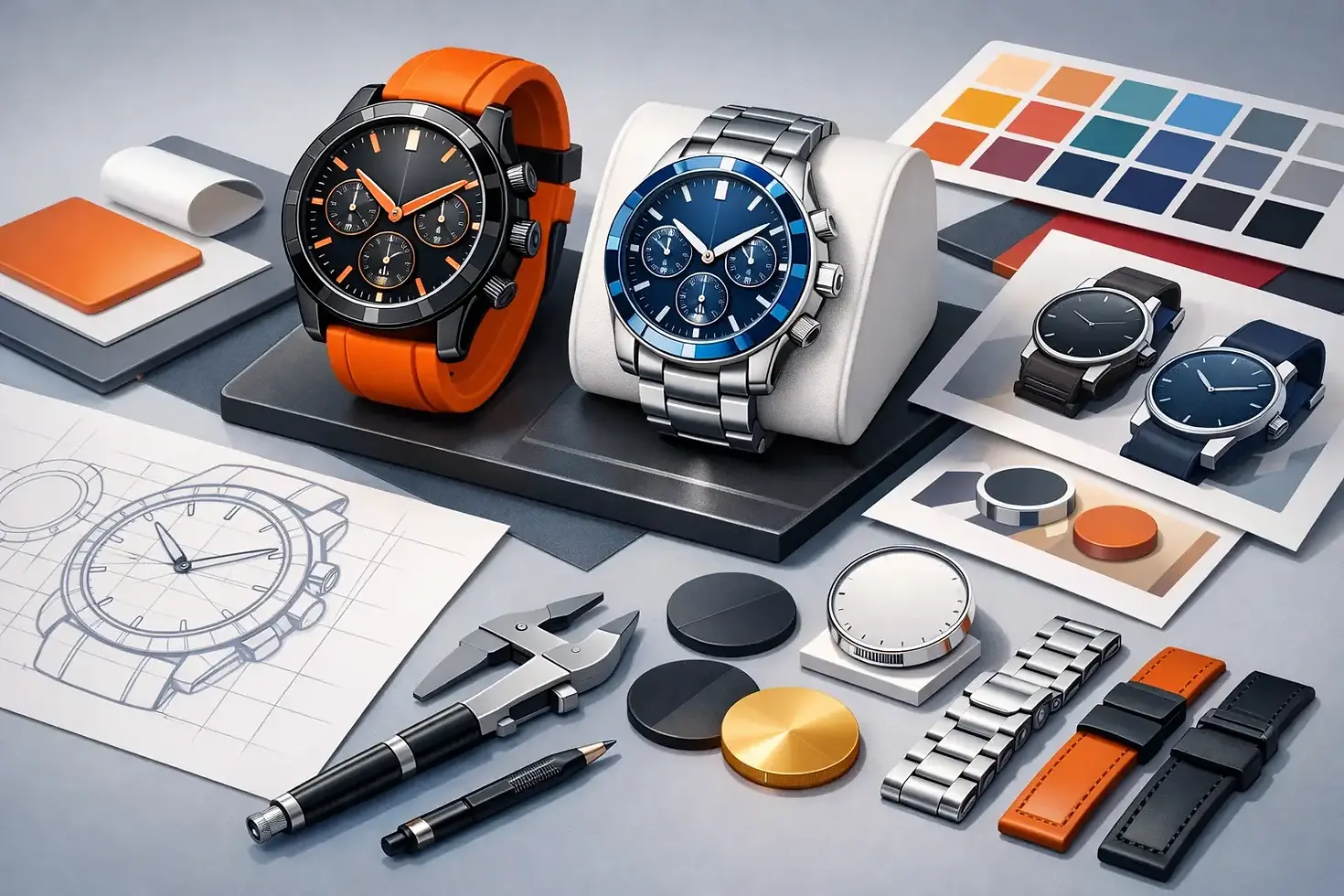
How to Design Branded Watches That Sell
- WILSON LEUNG
- Apr 30
- 6 min read
A branded watch fails long before production if the product brief is weak. Many buyers focus first on logos, dial colors, or packaging, but the real work starts earlier. If you want to understand how to design branded watches for retail, promotional, or private-label use, you need to align brand position, target price, technical specifications, and manufacturing realities from the beginning.
For B2B buyers, watch design is not just a creative exercise. It is a product development process with cost, lead time, quality, and brand consistency tied together. A good-looking concept is not enough if the watch cannot be produced reliably, priced correctly, or repeated across future orders. That is why the strongest watch programs start with clear decisions and disciplined execution.
Start with market position before design
The first design decision is not the case shape. It is the market position of the product. A branded watch for a fashion retailer will be developed differently from a watch for a corporate gifting program or a private-label startup building a permanent collection.
You need to define who will buy it, where it will sell, and what price range the market will accept. That target retail price will affect nearly every technical choice, including movement type, case material, crystal, strap construction, water resistance, and packaging level. If your market expects a $79 watch, the design approach will be very different from a product planned for $249 retail.
This is where many projects drift off course. A buyer may request premium materials, custom tooling, and complex dial details while keeping a low target price. The result is usually compromise later in development. A more effective approach is to set the commercial framework first, then design within it.
How to design branded watches with a clear product brief
A proper brief keeps development efficient. It also helps your OEM or ODM manufacturing partner guide you toward practical choices instead of repeated revisions.
At minimum, the brief should define your target customer, expected retail price, order volume, launch timing, and brand style. From there, it should cover the core watch specifications. These include case size, case material, movement preference, dial layout, hands, markers, strap type, buckle, water resistance target, logo placement, and packaging requirements.
You do not need to finalize every detail on day one. But you do need to establish direction. For example, saying you want a clean men's quartz watch for department store distribution is useful. Saying you want something premium and modern is not enough on its own.
A strong manufacturing partner can help refine unclear points, but the process moves faster when the buyer has a structured brief. It reduces sampling rounds, shortens approval time, and improves cost control.
Build the design around the customer, not just the logo
Branding a watch is more than printing a logo on the dial. The product needs to feel consistent with the brand's market identity. A minimalist fashion brand may need thin cases, restrained dial graphics, and neutral finishes. A sport-oriented brand may need stronger water resistance, more visible hands, and a heavier case profile. A promotional program may prioritize broad appeal, stable pricing, and fast repeatability.
The dial is often treated as the main branding surface, but it should not carry the whole burden. Good branded watch design works through the complete product. Case finish, crown shape, strap texture, buckle engraving, caseback marking, and packaging all contribute to brand recognition.
There is also a trade-off here. The more aggressive the branding, the narrower the appeal can become. A large logo may support promotional distribution, but it may reduce everyday wearability in retail channels. In contrast, subtle branding can create stronger long-term product value, especially for private-label collections.
Choose specifications that support the price target
Once the concept is clear, specification discipline matters. This is where design ambition meets production reality.
Movement selection is usually one of the most important decisions. Quartz remains the practical choice for many branded programs because it offers stable performance, lower cost, and easier maintenance. Automatic movements can raise perceived value, but they also increase cost, case thickness, and quality control requirements. The right choice depends on the brand position and expected retail margin.
Case material also shapes both cost and perception. Stainless steel supports stronger durability and a more premium feel, while alloy cases may suit lower-cost fashion or promotional products. Crystal choice follows the same logic. Mineral glass is common and cost-effective, while sapphire offers higher scratch resistance at a higher unit cost.
Straps deserve more attention than they often receive. A watch may be approved based on the dial, but customer satisfaction is heavily influenced by how the strap feels and wears. Genuine leather, stainless steel bracelets, mesh bands, silicone, and PU all serve different markets. The right option depends on both price and use case.
None of these decisions should be made in isolation. When buyers ask how to design branded watches successfully, the practical answer is to build a specification package where every part supports the same market goal.
Balance originality with manufacturability
Many buyers want a watch that looks exclusive, which is reasonable. The question is how much customization is necessary to achieve that goal.
Some branded watch programs work well with existing case platforms combined with custom dials, hands, straps, colors, and packaging. This route is usually faster and more cost-efficient. It can still create a distinctive product if the design language is handled carefully.
Other projects require fully custom components, especially when brand identity depends on a unique case shape or signature construction. That can strengthen differentiation, but it also means higher development cost, tooling investment, and more sampling time. For lower volumes, fully custom structures are not always the best commercial decision.
This is one of the most important trade-offs in OEM and ODM work. Originality matters, but so does repeatable production. A well-developed semi-custom watch often performs better than an overdesigned product that becomes difficult to manufacture consistently.
Sampling is where the real design work happens
Digital artwork can make almost any watch look finished. Sampling shows whether the product actually works.
At sample stage, small issues become visible. Dial print may look too heavy. Hands may blend into the background under certain lighting. Case finishing may feel too sharp or too soft for the intended market. Strap color may not match packaging as expected. These are not minor details. They shape whether the final product feels cheap, balanced, or credible.
Buyers should review samples against the original brief, not just personal taste. The sample must answer practical questions. Does it match the target customer? Does it justify the expected retail price? Is the brand identity clear without overloading the design? Can quality be repeated in bulk production?
A dependable manufacturing partner will also use this stage to flag risks before mass production. That is one reason experienced OEM and ODM support matters. Development is not just about taking instructions. It is about preventing avoidable errors.
Packaging and presentation are part of the product
For branded watches, packaging should be planned early, not added at the end. Retail presentation affects perceived value, and in gift or promotional channels it can strongly influence buyer response.
The packaging does not need to be elaborate to work well. It needs to fit the brand and the price point. A clean, well-made box with correct logo application and protective interior can outperform oversized packaging that adds cost without improving perception.
It also helps to think beyond first delivery. If the watch line is meant to expand, packaging should be scalable across future SKUs. Consistency helps build brand recognition, and it avoids redesign costs later.
Plan for production, not just launch
A branded watch line should be designed for repeat orders from the beginning. That means confirming material availability, acceptable tolerances, finishing consistency, testing standards, and approval procedures before mass production starts.
This is especially important for growing brands and distributors. A successful first order creates pressure for replenishment, seasonal variation, or line extension. If the original design relies on unstable materials or unclear specifications, scaling becomes difficult.
Working with an experienced manufacturer such as HONOUR TIME CORPORATION LTD. can help buyers structure development with production in mind. That matters because the goal is not only to launch one attractive watch. The goal is to build a product program that can be produced reliably as the business grows.
The best branded watches are not the ones with the most decoration. They are the ones designed with a clear market purpose, controlled specifications, and manufacturing discipline behind every detail. If the product makes sense on paper before it reaches the sample table, you are already ahead of most watch projects.


Comments